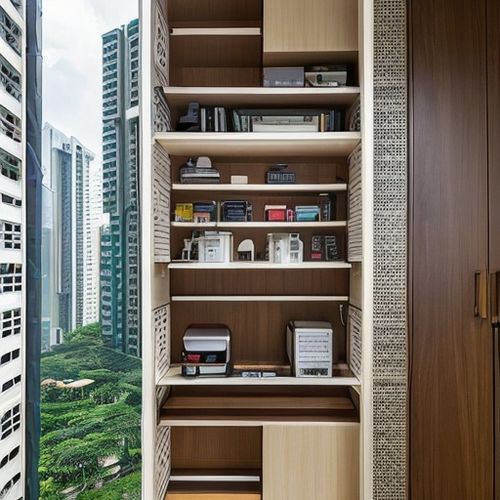
In the heart of Singapore's bustling urban landscape, a quiet revolution in home design is taking place. The city-state's iconic Housing and Development Board (HDB) flats have long been celebrated for their efficient use of space, but recent innovations in "hidden furniture" systems are pushing boundaries further than ever before. Among these breakthroughs, the bed-cabinet transformation system stands out as a marvel of functional design that perfectly encapsulates Singapore's philosophy of living well in compact spaces.
The concept of convertible furniture isn't new, but Singaporean designers have elevated it to an art form. Walking into a modern HDB flat today, you might see what appears to be an ordinary wall cabinet - until with a simple motion, it unfolds into a comfortable sleeping space. This seamless transformation happens without sacrificing storage capacity or requiring complicated mechanical operations. The bed doesn't just fold down; it becomes part of an integrated living system where every centimeter serves multiple purposes.
What makes these systems uniquely Singaporean is their meticulous attention to the realities of tropical living. The materials are specially selected to withstand humidity while remaining lightweight enough for daily operation. Ventilation is built into the design to prevent moisture buildup, and the mechanisms are engineered for silent operation - crucial in homes where space is shared and privacy is at a premium. Many systems incorporate smart features like soft-close mechanisms and integrated lighting that activates when the bed is deployed.
The psychological impact of these designs cannot be overstated. Where traditional fold-out beds might make residents feel they're living in temporary accommodations, these sophisticated systems provide a sense of permanence and quality. The cabinet surfaces maintain their elegance whether in bed or storage configuration, and the transitions feel intentional rather than makeshift. It's this emotional intelligence in design that sets Singapore's approach apart from simple space-saving tricks seen elsewhere.
Behind these consumer-facing innovations lies a fascinating ecosystem of research and development. Singapore's universities collaborate with HDB and private designers through programs like the Singapore Institute of Technology's Architecture and Sustainable Design degree, where students tackle real-world space challenges. Government grants support small businesses developing new space-saving technologies, creating a pipeline of innovation that keeps Singapore at the forefront of compact living solutions.
The economic implications are equally compelling. By reducing the minimum space required for comfortable living, these designs make home ownership more accessible while maintaining quality of life. Real estate professionals note that flats featuring high-quality transformable systems command premium prices and attract younger buyers who prioritize smart design over square footage. This has created a virtuous cycle where demand for better space solutions drives further innovation.
Looking forward, the next generation of these systems is already taking shape. Prototypes in experimental HDB units incorporate motorized transformations activated by voice commands or smartphones. Some integrate biometric sensors to adjust sleeping surfaces based on occupants' preferences, while others explore materials that change properties based on temperature or humidity. What began as a practical solution to space constraints is evolving into a showcase for Singapore's design and engineering capabilities.
Perhaps most impressively, these innovations have begun influencing global furniture markets. International manufacturers are studying Singapore's approaches as urban populations worldwide face similar space pressures. The tiny house movement in America, micro-apartments in European capitals, and compact living solutions across Asian megacities all show traces of inspiration from Singapore's hidden furniture revolution.
Yet for all their technical sophistication, these systems ultimately serve a profoundly human purpose. They represent a belief that limited physical space need not constrain quality of life or personal expression. In a world where urbanization continues to accelerate, Singapore's hidden furniture solutions offer more than just smart design - they provide a vision for how we might all live well in the cities of the future.
By Emily Johnson/Apr 14, 2025
By Amanda Phillips/Apr 14, 2025

By Jessica Lee/Apr 14, 2025
By John Smith/Apr 14, 2025

By Thomas Roberts/Apr 10, 2025

By Amanda Phillips/Apr 14, 2025
By Michael Brown/Apr 14, 2025
By Jessica Lee/Apr 14, 2025

By Elizabeth Taylor/Apr 14, 2025

By Elizabeth Taylor/Apr 10, 2025

By Sophia Lewis/Apr 14, 2025
By William Miller/Apr 14, 2025
By John Smith/Apr 14, 2025
By Emily Johnson/Apr 14, 2025
By Emma Thompson/Apr 14, 2025
By Sarah Davis/Apr 10, 2025
By David Anderson/Apr 14, 2025
By Emily Johnson/Apr 14, 2025

By Eric Ward/Apr 14, 2025
By Eric Ward/Apr 14, 2025