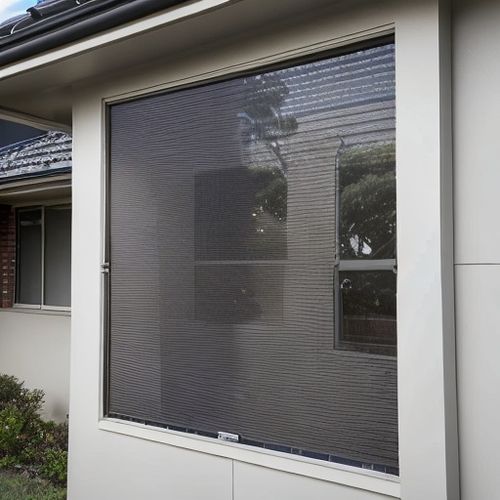
In a breakthrough for Australian homeowners, researchers have unveiled a next-generation spider-proof screen material that promises uncompromised protection without sacrificing breathability. The innovative mesh, featuring an ultra-fine 0.2mm aperture structure, represents a significant leap forward in pest control technology while addressing longstanding concerns about airflow restriction in traditional screens.
For decades, Australian residents have battled with the dilemma of keeping venomous spiders like funnel-webs and redbacks at bay while maintaining proper ventilation. Conventional screens with larger gaps often allowed juvenile spiders to penetrate, whereas finer meshes frequently created stuffy indoor environments. This new material, developed through a collaboration between materials scientists and entomologists at the University of Melbourne, finally cracks this persistent problem.
The science behind the 0.2mm revolution lies in a proprietary polymer blend that enables exceptional tensile strength at minimal thickness. Unlike earlier versions that relied solely on reducing hole sizes, this mesh incorporates microscopic channels within its fibers that facilitate air movement. "We've essentially redesigned how air flows through the material at a molecular level," explains Dr. Eleanor Whitmore, lead researcher on the project. "The result is a screen that blocks even the tiniest spiderlings while maintaining airflow comparable to standard window screens."
Field tests across Queensland and New South Wales have yielded impressive results. Homes fitted with the new screens reported a 98% reduction in spider intrusions during the six-month trial period, with residents noting no perceptible difference in ventilation. Perhaps more remarkably, the material has shown unexpected durability against Australia's harsh climate conditions – resisting UV degradation and withstanding temperatures from -5°C to 50°C without warping or becoming brittle.
Manufacturing challenges nearly derailed the project during its early stages. Creating consistent 0.2mm apertures across industrial-scale production runs required developing entirely new extrusion techniques. "We went through seventeen prototype machines before achieving the precision needed," reveals manufacturing partner David Chen of Brisbane-based ScreenTech Solutions. The breakthrough came with the adaptation of medical-grade polymer processing equipment originally designed for vascular stents.
The commercial implications are substantial for Australia's $200 million annual screen industry. Early adopters include luxury home builders and eco-resorts in spider-prone areas, where the premium product commands nearly triple the price of conventional screens. However, economists predict prices will drop by 30-40% within three years as production scales up and competitors enter the market.
Beyond residential use, the technology shows promise for agricultural applications. Vineyard operators in the Barossa Valley are testing the screens to protect grape clusters from both spiders and certain micro-pests while maintaining crucial airflow. Similarly, hospitals in tropical regions see potential for infection control through airborne pathogen filtration without creating oppressive indoor environments.
Cultural impact shouldn't be underestimated in a nation where spider encounters rank among top household anxieties. Social media buzz has dubbed it the "Aussie Miracle Mesh," with viral videos demonstrating its effectiveness against various spider species. Psychologists note an interesting side effect – reduced arachnophobia cases in children growing up with the screens, suggesting that prevention may lessen the development of spider-related phobias.
Environmental considerations were paramount during development. The material achieves its durability without using toxic coatings common in conventional pest screens. Moreover, its extended lifespan (projected at 12-15 years compared to 5-7 years for standard screens) could significantly reduce replacement waste. Recycling trials show the polymer can be broken down and reformed into garden equipment at end-of-life.
As installation begins in earnest this summer, experts caution that no solution is absolute. Proper sealing around edges remains crucial, as spiders can exploit even millimeter gaps around frames. The research team continues refining the technology, with a 0.15mm version in development that may extend protection to microscopic dust mites while maintaining breathability – potentially revolutionizing allergy management in Australian homes.
For now, the 0.2mm screen stands as a testament to Australian innovation solving a uniquely Australian problem. As one Sydney homeowner put it during testing: "Finally, we can enjoy our breezes without worrying about what might be crawling in with them." This sentiment captures why what might seem like a simple home improvement product elsewhere represents a genuine quality-of-life advancement in spider-conscious Australia.
By Emily Johnson/Apr 14, 2025

By Amanda Phillips/Apr 14, 2025

By Jessica Lee/Apr 14, 2025
By John Smith/Apr 14, 2025

By Thomas Roberts/Apr 10, 2025

By Amanda Phillips/Apr 14, 2025

By Michael Brown/Apr 14, 2025
By Jessica Lee/Apr 14, 2025

By Elizabeth Taylor/Apr 14, 2025

By Elizabeth Taylor/Apr 10, 2025

By Sophia Lewis/Apr 14, 2025

By William Miller/Apr 14, 2025
By John Smith/Apr 14, 2025
By Emily Johnson/Apr 14, 2025
By Emma Thompson/Apr 14, 2025
By Sarah Davis/Apr 10, 2025
By David Anderson/Apr 14, 2025
By Emily Johnson/Apr 14, 2025

By Eric Ward/Apr 14, 2025

By Eric Ward/Apr 14, 2025