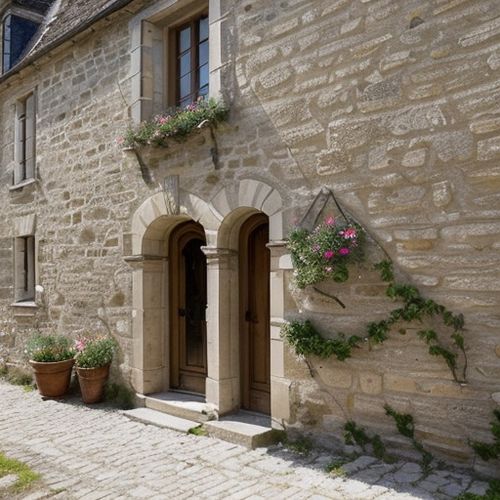
In the heart of France’s historic districts, a quiet revolution is taking place—one that marries centuries-old craftsmanship with modern sustainability goals. The focus is on the country’s aging stone buildings, long admired for their charm but notorious for their poor insulation. Rather than opting for synthetic materials or disruptive retrofits, architects and builders are turning to traditional techniques to improve energy efficiency. This revival of "stone wall insulation" methods is not just about preserving heritage; it’s a pragmatic response to the climate crisis, offering lessons for Europe and beyond.
The challenge of insulating stone buildings is uniquely French in many ways. France boasts over 500,000 stone-built homes, many dating back to the 18th and 19th centuries. These structures, with their thick limestone or granite walls, were designed to regulate temperature naturally—cool in summer, moderately warm in winter. But as heating standards evolved, their thermal performance became inadequate. Post-war interventions often relied on cement-based renders or internal drywall, which trapped moisture and accelerated decay. "We’ve spent decades making these buildings sick," says Thierry Boissière, a Lyon-based conservation architect. "Now we’re learning to work with the stone, not against it."
At the core of this movement is the rediscovery of chaux (lime mortar), the original binding material used in stone construction. Unlike cement, lime is breathable, allowing moisture to evaporate while maintaining structural integrity. Mixed with hemp or cork aggregates, it creates an insulating layer that can be applied internally or as an external render. In the Loire Valley, teams are using a 15th-century recipe—lime putty combined with horsehair—to fill gaps between stones without compromising their thermal mass. The results are striking: some buildings have seen heating demands drop by 40% without altering their historic facades.
Another technique gaining traction is the double-wall approach, where a secondary inner wall of porous brick or terre crue (raw earth) is built with an air gap. This mimics the ancestral "mur à pierres vues" (visible stone wall) method but enhances insulation. In Périgord, a 1780s farmhouse retrofit used locally sourced clay bricks, reducing energy loss while maintaining the original stone’s aesthetic. "It’s not nostalgia," insists materials engineer Élodie Marchand. "Earth and lime have lower embodied carbon than fiberglass or polystyrene. They’re also hygroscopic—they absorb and release humidity, creating healthier interiors."
The push for traditional methods isn’t without hurdles. Skilled artisans capable of working with lime or hand-laying earth bricks are scarce, and training programs struggle to keep pace with demand. Costs, too, can be 20-30% higher than conventional insulation. Yet municipalities are stepping in. The city of Rennes offers subsidies covering up to 50% of restoration costs if homeowners use approved natural materials. Meanwhile, France’s École de Chaillot has launched a specialization in "bio-sourced retrofits," blending heritage conservation with passive-house principles.
Perhaps the most compelling aspect of this trend is its ripple effect. Belgian and Italian architects are studying French models for their own medieval buildings. Even new constructions are borrowing ideas: a Parisian housing project recently featured load-bearing limestone walls with hemp-lime infills, achieving Passivhaus certification. As climate regulations tighten, the wisdom embedded in these old stones seems increasingly relevant. "We used to see tradition and innovation as opposites," reflects Boissière. "Now we understand—they’re the same conversation across different centuries."
Walking through the cobbled streets of Avignon or Toulouse today, the evidence is subtle but profound. Fresh lime washes glow softly on ancient walls; restored timber shutters complement original stonework. The buildings stand not as relics but as active participants in France’s energy transition. In an era obsessed with high-tech solutions, there’s poetic justice in the fact that some of the most sustainable answers lie in techniques our great-great-grandparents would recognize. The stones, it seems, have been waiting for us to remember.

By Emily Johnson/Apr 14, 2025
By Amanda Phillips/Apr 14, 2025

By Jessica Lee/Apr 14, 2025
By John Smith/Apr 14, 2025

By Thomas Roberts/Apr 10, 2025

By Amanda Phillips/Apr 14, 2025
By Michael Brown/Apr 14, 2025
By Jessica Lee/Apr 14, 2025

By Elizabeth Taylor/Apr 14, 2025

By Elizabeth Taylor/Apr 10, 2025

By Sophia Lewis/Apr 14, 2025

By William Miller/Apr 14, 2025

By John Smith/Apr 14, 2025

By Emily Johnson/Apr 14, 2025
By Emma Thompson/Apr 14, 2025

By Sarah Davis/Apr 10, 2025

By David Anderson/Apr 14, 2025
By Emily Johnson/Apr 14, 2025

By Eric Ward/Apr 14, 2025

By Eric Ward/Apr 14, 2025