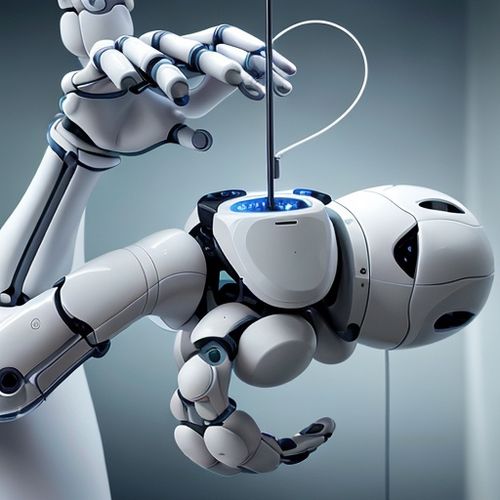
The concept of soft robotics has emerged as a revolutionary field, blending the flexibility of biological systems with the precision of engineering. Unlike traditional rigid robots, soft robots are constructed from compliant materials that allow for adaptive and resilient movements. This innovation opens doors to applications where conventional robots would fail, such as delicate surgical procedures or navigating unpredictable terrains. The development of soft robotics is not just an advancement in technology; it represents a paradigm shift in how we perceive machines interacting with the world.
One of the most intriguing aspects of soft robotics is the use of pneumatic or hydraulic actuation. These systems rely on air or fluid pressure to create motion, mimicking the way muscles contract and expand. By carefully controlling the pressure within silicone-based chambers, researchers can achieve complex movements without the need for rigid joints or motors. This approach not only reduces mechanical complexity but also enhances the robot's ability to conform to its environment. For instance, a soft robotic gripper can gently pick up fragile objects without risking damage, a task that would challenge even the most advanced rigid grippers.
The materials used in soft robotics play a pivotal role in their functionality. Silicone elastomers, for example, offer a combination of durability and flexibility that is essential for repeated deformation. These materials can withstand significant strain while maintaining their structural integrity, making them ideal for dynamic applications. Additionally, advancements in self-healing polymers are pushing the boundaries further, enabling soft robots to repair minor damages autonomously. This self-repair capability is particularly valuable in environments where human intervention is impractical, such as deep-sea exploration or space missions.
Despite their many advantages, soft robots face unique challenges. One of the primary hurdles is the development of efficient control systems. Unlike rigid robots, which operate with precise kinematic models, soft robots exhibit nonlinear behaviors that are difficult to predict. Researchers are exploring machine learning techniques to tackle this issue, training algorithms to adapt to the robot's dynamic responses in real time. Another challenge lies in powering these devices. Traditional batteries are often too heavy or inflexible, prompting investigations into alternative energy sources like biofuel cells or even energy harvesting from the environment.
The potential applications of soft robotics are vast and varied. In the medical field, soft robotic devices are being designed for minimally invasive surgeries, offering greater precision and reducing patient trauma. In disaster response, soft robots could navigate through rubble to locate survivors, their flexible bodies allowing them to squeeze into tight spaces. Even in everyday life, soft robotics could revolutionize industries like agriculture, where gentle handling of produce is crucial. The adaptability of these systems ensures that their impact will be felt across multiple sectors.
Looking ahead, the future of soft robotics is brimming with possibilities. Researchers are experimenting with biohybrid systems, integrating living cells into robotic structures to create machines that blur the line between biology and engineering. Such innovations could lead to robots capable of self-replication or even symbiotic relationships with biological organisms. As the field continues to evolve, ethical considerations will also come to the forefront, particularly regarding the autonomy and decision-making capabilities of these machines. The journey of soft robotics is just beginning, and its trajectory promises to redefine our relationship with technology.

By Joshua Howard/Apr 19, 2025

By Amanda Phillips/Apr 19, 2025

By Samuel Cooper/Apr 19, 2025

By George Bailey/Apr 19, 2025

By Ryan Martin/Apr 19, 2025

By Emily Johnson/Apr 19, 2025

By Elizabeth Taylor/Apr 19, 2025

By Christopher Harris/Apr 19, 2025

By Ryan Martin/Apr 19, 2025

By Emma Thompson/Apr 19, 2025

By Emily Johnson/Apr 19, 2025

By Victoria Gonzalez/Apr 19, 2025

By Jessica Lee/Apr 19, 2025
By Sophia Lewis/Apr 19, 2025